

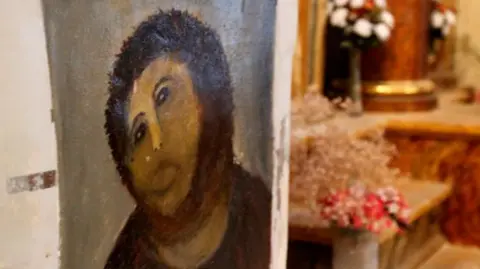
The Spanish parishioner who achieved global fame for her poorly executed repair job on a cherished religious painting has died at the age of 94.
Cecilia Giménez, from the town of Borja in northeast Spain, became a global sensation 13 years ago after she attempted to restore a 100-year-old painting known as Ecce Homo located in her parish church.
Giménez's handiwork quickly went viral and was dubbed "Potato Jesus", largely due to the altered likeness of Christ's head bearing a resemblance to a hairy monkey.
Local Confirmation and Tribute
The 94-year-old's passing was confirmed by the town's mayor, Eduardo Arilla, in a social media post, where he described her as a "great lover of painting from a young age".
"Rest in peace Cecilia, we will always remember you," the mayor posted.
Arilla also paid tribute to Giménez's "famous restoration of Ecce Homo" in the summer of 2012, which "because of the poor state of conservation it was in, Cecilia, acting in good faith, chose to apply new paint over the original".
The Artwork's History and the Fateful Intervention
The Ecce Homo ("This is the Man" in Latin) painted by nineteenth-century painter Elias Garcia Martinez had been held for more than a hundred years in the Sanctuary of Mercy Church close to Zaragoza.
In 2012, Giménez, then 81, explained that church members had "always repaired everything here", and that she had been given the go-ahead from the parish priest to do the work.
She added at the time that anyone who came into the Church would have seen she was painting over the original artwork.
An Unexpected Tourist Boom
The impact of the restoration spawned the "Ecce Mono" meme and transformed the previously sleepy town of Borja quickly become a major tourist destination.
The municipality, which had previously seen only five thousand visitors per year, received more than 40,000 tourists by 2013, and generated over €50,000 for charity from the interest.
Currently, officials estimate that somewhere around 15,000 and 20,000 tourists travel to Borja each year to view the notorious painting, which is now protected by a protective shield of glass.
Legacy and Local Support
Following the wave of criticism, backed by the townspeople and others around the world, Giménez later stage an exhibition of her paintings showcasing twenty-eight of her own paintings.
She was praised by Borja's mayor for her generosity and years of dedication to the church.
In the end, what began as a sincere but flawed art repair created an improbable cultural icon and provided unprecedented attention and resources to a small Spanish town.


